Actuator
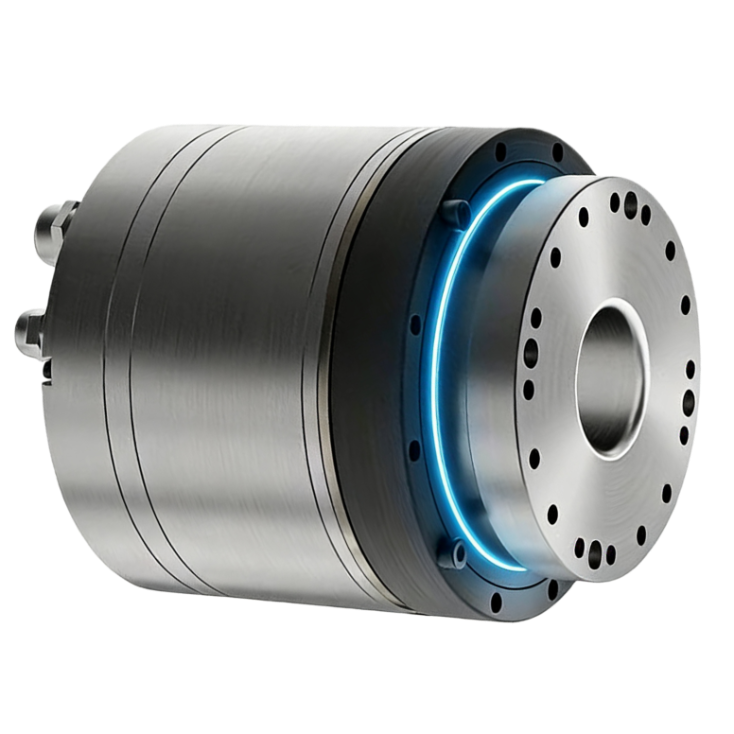
Robot Joint Module
A rotary joint allows for rotational movement between two links around a single fixed axis. It is the most common joint type in robotics, functionally similar to a human elbow or knee, to provide flexibility and articulation.

Core Internal Components
- Motors: The "muscles" that drive motion by converting electrical, hydraulic, or pneumatic energy into mechanical movement. Servo motors are the standard for high-precision applications.
- Reducers: Components like harmonic drives or planetary gearboxes reduce the motor's speed while significantly increasing output torque.
- Sensors: These provide critical real-time feedback.
- Encoders measure position and velocity, while force/torque sensors detect force and torque, enabling safe interaction with objects
- Bearings: Used to reduce friction and wear, ball bearings are common for rotary joints, while linear bearings support sliding prismatic motion.
- Housing and Links: Structural frames made from materials like aluminum, steel, or carbon fiber to balance durability with lightweight movement.
Applications and Advantages
Rotary joints are prized for their simplicity and efficiency in complex workspaces.
- Industrial Arms: Multiple rotary joints (e.g., a 6-axis robot) allow for intricate maneuvers in welding, painting, and assembly.
- SCARA Robots: Combine rotary joints for horizontal movement with a prismatic joint for vertical reach, ideal for high-speed pick-and-place.
- Humanoid Robots: Use specialized rotary modules for hips, shoulders, and wrists to mimic human-like dexterity.
- Medical Robotics: Enable the high precision and sensitivity required for minimally invasive surgeries.